Pedagogy 10 min read September 2026

AI and Universal Design for Learning

UDL has always been the right framework for every classroom. The reason it stayed a theory is that no teacher could build five versions of every lesson. AI changes that. Here is a principle-by-principle table of how.

Part 3 of the AI in Schools series

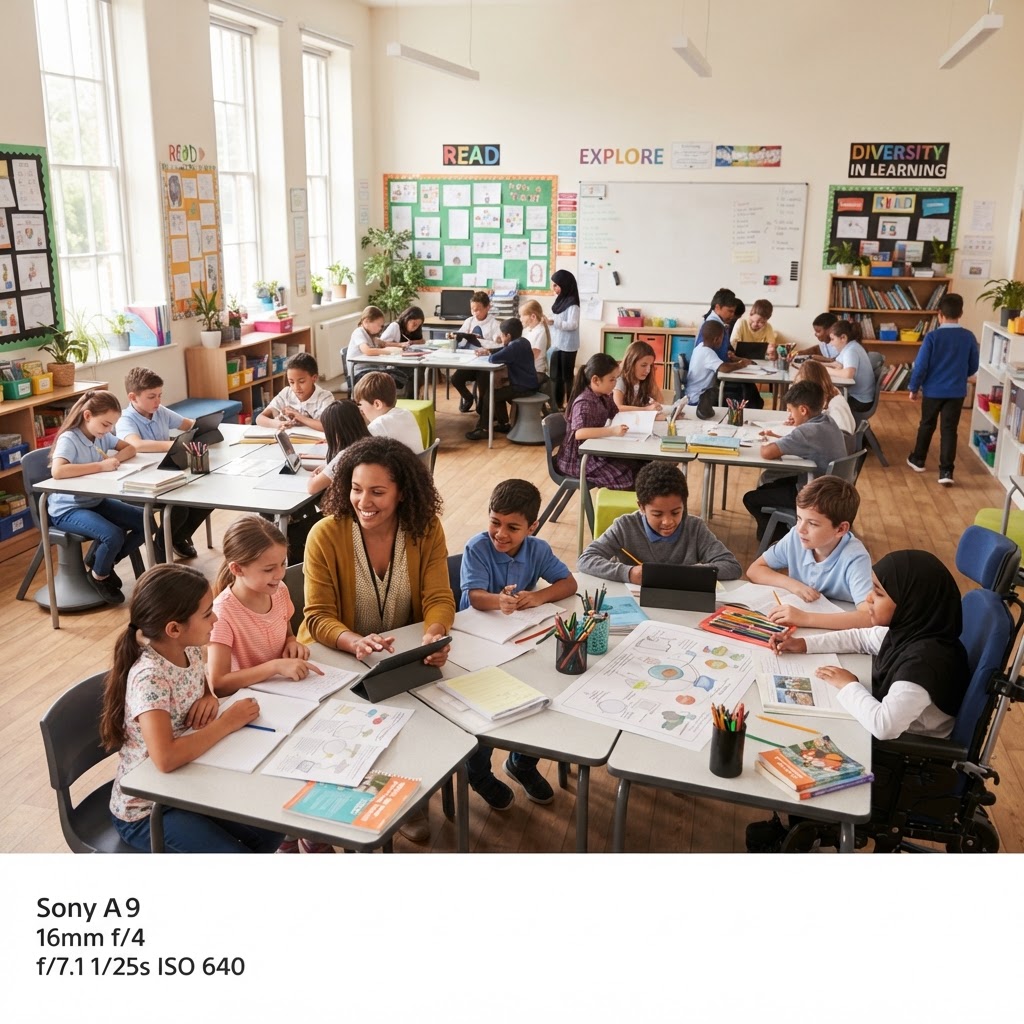
A diverse classroom with multiple learning materials and formats

The Quick Answer (AEO Summary)

How does AI help with Universal Design for Learning (UDL)? UDL asks teachers to provide multiple means of Engagement (the why), Representation (the what), and Action and Expression (the how). The barrier has always been scale — a teacher with 30 students cannot manually create multiple versions of every lesson. AI makes UDL practical: it generates differentiated versions, converts content between formats (text, audio, diagram), adjusts reading levels, connects content to student interests, and provides multiple entry points — all in seconds. The table below maps each UDL guideline to a specific AI application. Used pedagogically (Socratic, not answer-giving), AI removes barriers to learning without removing the learning.

Background

What is UDL, and why has it stayed a theory?

Universal Design for Learning is a framework from CAST that says every lesson should give students multiple ways to engage with the material, multiple ways to access the content, and multiple ways to show what they know. It is not a special-education framework — it is an every-student framework. The students who need it most are often the ones who would never be identified for support.

The reason UDL stayed a theory is simple: it asks a teacher to build three to five versions of every lesson. No teacher with 30 students and five preps can do that. AI is the first tool that makes the multiple-means part of UDL achievable in a real classroom, in real time.

The UDL + AI principle-by-principle table

Each UDL principle, its guidelines, and a concrete way AI helps with each — without doing the learning for the student.

Multiple Means of Engagement

"Why am I learning this?"

Individual choice and autonomy

AI lets students choose their own entry point — topic, format, or difficulty — without the teacher building five separate versions. A student who picks their own essay prompt from AI-generated options is more invested than one handed a prompt.

Relevance, value, and authenticity

AI can connect any topic to a student's interest in seconds. "Explain photosynthesis using basketball" is a relevance move a teacher could not scale for 30 students without AI.

Optimizing threats and coping

A Socratic AI tutor lowers the stakes — students can ask a question without fear of looking lost in front of peers. The AI does not judge; it asks the next question.

Collaboration and community

AI chatbots can facilitate group roles, generate discussion prompts at multiple levels, and give each group a different angle on the same question.

Monitoring progress

AI tracks learning outcomes across sessions and surfaces where a student is stuck — giving the teacher data to act on without grading 30 exit tickets by hand.

Multiple Means of Representation

"What am I learning?"

Perceptual clarity and options

AI can convert the same content into text, audio, a diagram, or a simplified summary on demand. A student who cannot access a dense text can get the same idea in a format that works for them.

Access to tools and assistive tech

AI-powered text-to-speech, translation, and reading-level adjustment are built into the generation — not bolted on afterward. Every output can be leveled to the student.

Clarity and structure

AI can break a wall of text into a graphic organizer, a step-by-step sequence, or a before-during-after structure. The representation matches the learner.

Language and symbols

AI can define jargon inline, translate to a student's first language, or generate an analogy for an abstract concept — all without the teacher writing a glossary.

Background knowledge

AI can surface the prior knowledge a student needs before they hit a new concept — a quick primer, a connection to something they already know, or a pre-teaching of key vocabulary.

Multiple Means of Action & Expression

"How do I show what I know?"

Access to tools and assistive tech

AI can help students who struggle with writing produce a first draft they can then revise — leveling the expression gap without doing the thinking for them.

Response and navigation

AI lets students respond in multiple formats — voice, text, a diagram, a structured outline — so the assessment measures understanding, not just writing fluency.

Monitoring progress

AI can give immediate, formative feedback on a draft before the teacher sees it — so the student revises toward the goal instead of waiting for a grade.

Managing information

AI can help students organize research, outline an argument, or structure a project — scaffolding the executive function some students need.

Expression and communication

AI can generate sentence starters, graphic organizer templates, or a modeled example so a student who freezes at a blank page has a way in.

Strategy development

A Socratic AI coach can model a problem-solving strategy out loud, then ask the student to apply it — teaching the strategy, not the answer.

The Line

Where is the line between scaffolding and doing the work?

UDL is about removing barriers to learning, not removing the learning. The line is whether the AI does the thinking or supports it. A Socratic AI that asks questions scaffolds. An AI that writes the essay does the work. A sentence starter scaffolds. A finished paragraph does the work.

The pedagogical approach matters more than the tool. The Secondary AI defaults to Socratic and inquiry-based approaches — the AI asks, the student thinks — so the UDL support stays on the right side of the line. The teacher sets the approach; the AI follows it.

This is Part 3 of 3

Read the full series

Related Reading

Make UDL Practical in Your Classroom

The Secondary AI generates differentiated bundles, adjusts reading levels, and defaults to Socratic approaches — so the three UDL principles are achievable in the time you actually have.