Cell Membrane Lab for SBI4U:
The Fluid Mosaic Model in Action
A free interactive where Grade 12 Biology students manipulate temperature, cholesterol, and transport proteins to see diffusion, aquaporins, and exocytosis happen on screen.
The quick answerThe Quick Answer
The Cell Membrane Lab is a free, browser-based interactive built for Ontario's SBI4U Biology course. Students change the temperature, add cholesterol, and switch on channel proteins, aquaporins, carriers, and pumps to watch the phospholipid bilayer respond in real time. They see diffusion happen, learn why aquaporins matter, and trigger exocytosis to export enzymes. It maps directly to the Biochemistry (B2, B3) and Homeostasis (E2, E3) strands, and it lives in the public library so any teacher can open it or copy it to their dashboard.
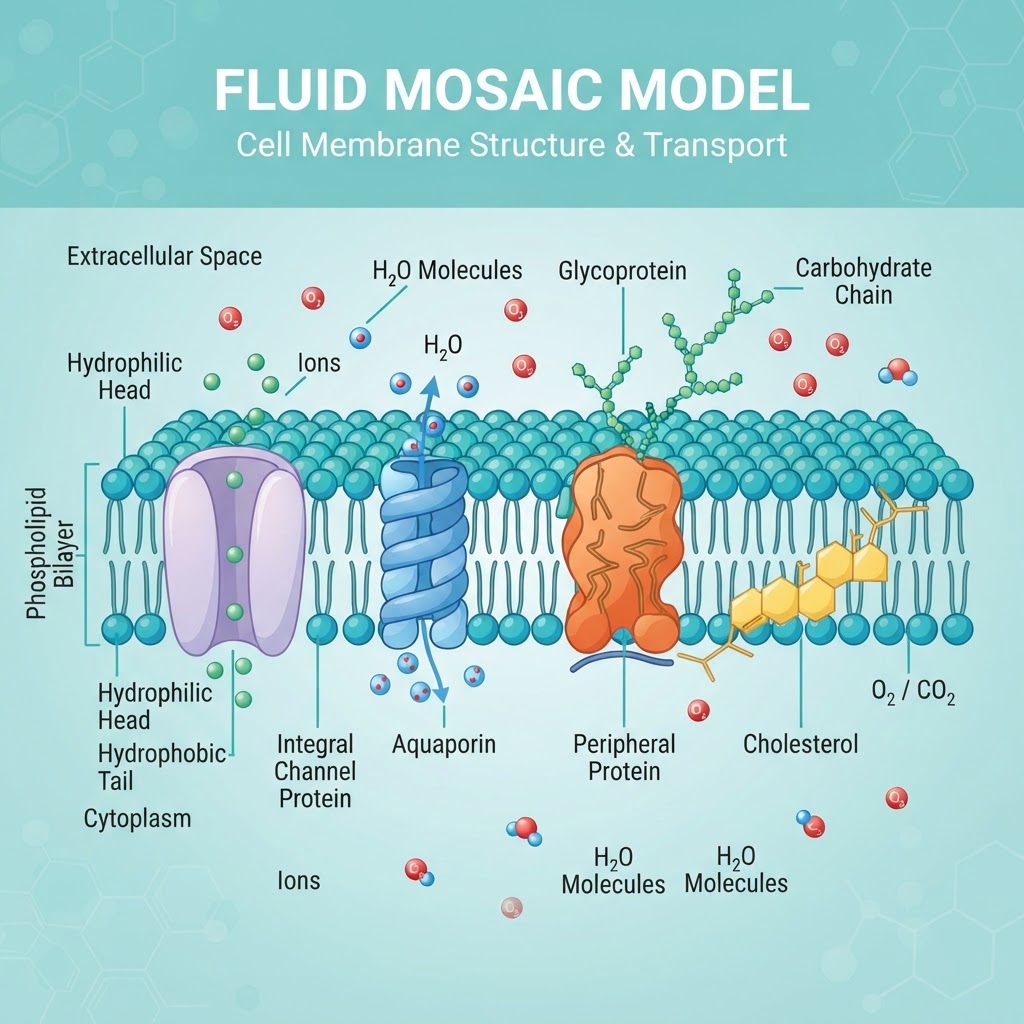
The fluid mosaic model is one of the hardest ideas in Grade 12 Biology to make stick. Students memorize that the membrane is "selectively permeable" and that proteins help things cross, but they rarely see any of it. A static diagram of a bilayer cannot show what happens when the cell gets cold, or why cholesterol matters, or why a cell that already lets water through would still need an aquaporin.
The Cell Membrane Lab fixes that. It is a live simulation: the bilayer breathes, the phospholipid tails wiggle, solutes drift, and proteins sit in the membrane doing their jobs. Every control a student touches produces a visible, countable change. By the end of a ten-minute investigation, students have seen diffusion, measured the difference an aquaporin makes, and caused exocytosis with their own click.
Open the Cell Membrane Lab
The interactive runs in any browser, no login required. Open it now with your students, or sign up free to copy it to your dashboard and share it via QR code.
No credit card required · Free to start · Works on Chromebooks and tablets
What Students Can Do
Change the temperature
A slider from 0 °C to 80 °C lets students push the bilayer from a rigid gel to a breaking, leaky mess, and watch how permeability tracks fluidity.
Add cholesterol
A second slider inserts cholesterol between the tails. Students discover its buffering role: it restrains movement when hot and prevents tight packing when cold.
Switch on transport proteins
Checkboxes insert a channel protein (ions), an aquaporin (water), a carrier (glucose), and an ATP-powered pump (ions out). Each one only moves the solute it is built for.
Trigger exocytosis
Add enzymes inside the cell and click "Send vesicle out." A vesicle forms, travels to the membrane, fuses, and releases the enzymes outside — the only way large molecules can leave.
A Ready-to-Use Investigation Sequence
The lab ships with a guided "Investigate" panel. Hand students these prompts and let them discover the science before you explain it.
Drop the temperature from 37 °C to 0 °C. How do the tails and lipid movement change, and what does that do to O₂ crossing?
Check the science: Cold packs phospholipids into a rigid gel, so movement and permeability drop.
Raise the temperature past 55 °C. What happens to the bilayer and to the solute counts?
Check the science: Too much heat overcomes the hydrophobic interactions holding the bilayer together, so it loses integrity and leaks.
Repeat both extremes with 40% cholesterol. What does cholesterol do at each end?
Check the science: Cholesterol buffers fluidity: it restrains movement when hot and stops tight packing when cold.
Turn on the aquaporin. How fast does water cross compared to when it is off?
Check the science: Aquaporins let water cross up to 10× faster than simple diffusion.
Add enzymes inside the cell and click "Send vesicle out". Why can enzymes not cross through channels or carriers?
Check the science: Large molecules are too big for any channel or carrier; exocytosis packages them into a vesicle that fuses with the membrane.
Why an Interactive Beats a Diagram
The membrane is a dynamic structure. That is the whole point of the word "fluid" in fluid mosaic. A textbook figure freezes the bilayer into a single pose, which is exactly the misconception the model exists to correct. When students can heat the membrane and watch it fall apart, or cool it and watch it lock up, the word "fluidity" stops being vocabulary and starts being something they have caused.
The lab also makes the logic of transport visible and countable. A running tally shows how many molecules crossed by each route — through the bilayer, via aquaporin, via channel, via carrier, via pump, via exocytosis, or by leaking through damage. Students do not have to take the teacher's word that aquaporins are faster; they watch the aquaporin count climb while the bilayer count barely moves.
Best of all, the investigation is inquiry-first. The prompts ask a question before they give an answer. A student who turns on the pump and watches ions move out against the gradient has to reconcile that with the diffusion they just observed — which is the exact cognitive conflict that makes active transport memorable.
Learning Outcomes
Describe the fluid mosaic model and explain how phospholipids, cholesterol, and proteins contribute to membrane structure.
Predict how temperature and cholesterol concentration affect membrane fluidity and permeability.
Distinguish between simple diffusion, facilitated diffusion, active transport, and exocytosis, and identify which solutes use each route.
Explain why aquaporins are necessary even though water can cross the bilayer on its own, and relate this to osmoregulation in kidney and red blood cells.
Ontario Curriculum Alignment
The activity directly supports the Biochemistry and Homeostasis strands in SBI4U (Grade 12 University Biology).
| Course | Strand | Expectation |
|---|---|---|
| SBI4U | Biochemistry · B2 | investigate the chemical structures, functions, and properties of a variety of biochemical compounds, including phospholipids and membrane proteins, and their roles in metabolic processes. |
| SBI4U | Biochemistry · B3 | demonstrate an understanding of the chemical structures and properties of biochemical compounds, including the hydrophilic and hydrophobic regions of the phospholipid bilayer. |
| SBI4U | Homeostasis · E2 | investigate the feedback mechanisms that maintain homeostasis in living organisms, including membrane transport and osmoregulation. |
| SBI4U | Homeostasis · E3 | demonstrate an understanding of the anatomy and physiology of human body systems, and explain the mechanisms that enable the body to maintain homeostasis, including selective permeability. |
Bring the Cell Membrane Lab to Your Students
Open the interactive free in any browser, or sign up to copy it to your dashboard, share it with a QR code, and pair it with your own AI chatbot for a full lesson bundle.