Vibe Coding in the
Humanities Classroom
New research from Brookings, MDPI, and Frontiers in Education confirms what Humanities teachers have always suspected: the best AI isn't the one that gives answers — it's the one that asks the right questions.
The most effective use of AI in education is not to provide answers. It's to facilitate a Productive Struggle.
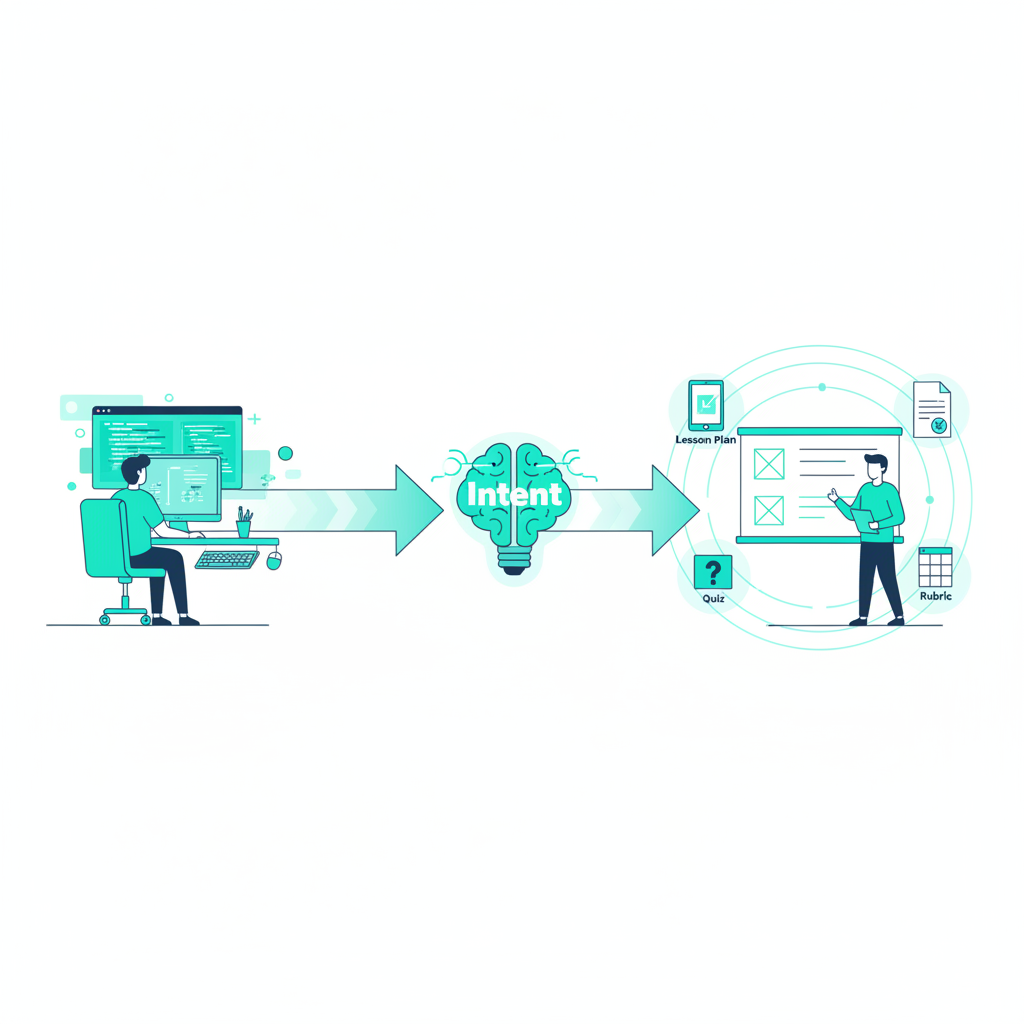
The transition from traditional, template-driven instruction to agentic, vibe-based learning represents the most significant paradigm shift in the educational landscape of 2026. Andrej Karpathy's concept of "vibe coding" — describing high-level intent to an AI that handles execution — has migrated from software development into the Humanities classroom. In the complex, inquiry-heavy environment of Grade 10 History, this translates into "vibe teaching": a methodology where educators trade rigid lesson templates for a dynamic Describe → Generate → Refine workflow.
Three landmark 2026 studies — from Frontiers in Education, MDPI, and the Brookings Institution — now give us the data to prove it works.
The Research
Question-Driven Dialogue and Cognitive Elaboration
A 2026 study published in Frontiers in Education examined how "question-driven dialogue" shapes student thinking during the critical prewriting and idea-formation phases. Researchers analyzed 201 question–response pairs from lower-secondary students in Norway, using a restricted GPT-4–based chatbot — programmed to ask only one question at a time and refuse to generate text on the student's behalf.
The tool drew on two complementary theoretical frameworks: a cognitive view of writing as goal-directed problem solving, and a sociocultural view of writing as mediated action. Cognitively, the AI functions as a "heuristic cue," externalizing parts of the planning process and extending the student's working memory. Socioculturally, the tool's refusal to generate text returns agency to the student — forcing them to take ownership rather than offloading the cognitive work to the machine.
The data reveals that sensory and memory-based questions are particularly effective at unlocking vivid student responses. 15 out of 30 coded sensory responses led to new, detailed descriptions that students would not have generated on their own.
"Productive Struggle keeps the slow, effortful work of idea generation with the learner — where it belongs."
— Frontiers in Education, 2026
Four Ways Students Engage
What the research identified: how students interact with Socratic AI.
Source: Frontiers in Education, 2026 — reflexive content analysis of 201 question–response pairs.
The Technical Framework
The SRVE Framework: How to operationalize vibe coding.
A 2026 case study published by MDPI examined how vibe coding enables educators without programming expertise to co-create HTML/JavaScript simulations — closing the gap between what simulation-based education can offer and what has historically been accessible to resource-constrained teachers. The research formalizes the Describe → Generate → Refine workflow into the SRVE framework, which maps natural language intent to functional educational artifacts.
The contribution of this workflow is not just technical — it is a democratization of pedagogy. It allows a history teacher to describe a complex historical "vibe" — the tension of the July Crisis, for instance — and have an agentic AI build a turn-based simulation that models the economic and diplomatic pressures of the era. This mirrors Karpathy's prediction of "a new kind of coding" where one fully gives in to the vibes and forgets the underlying syntax.
The Proof
Socratic AI more than doubles learning gains.
A 2026 report from the Brookings Institution provides outcome-based proof that students using AI-enhanced adaptive paths reach proficiency 40–60% faster than those in traditional settings. Tutoring systems that incorporate generative AI to formulate dynamic questions based on student input have shown the ability to "more than double" learning gains compared to active lecture groups.
Beyond quantitative scores, the research emphasizes the creation of "psychologically safe" learning environments. In a Grade 10 History classroom, students are often hesitant to reveal gaps in their understanding of complex geopolitical concepts in front of peers. AI tutors respond with infinite patience and non-judgmental support — leading to a 54% increase in test scores in active learning environments as the "Confidence Gap" collapses.
Source: Brookings Institution, 2026.
The Ethical Framework
The Oxford Rubric™ (2026): The gating factor every teacher needs.
As vibe coding allows for the rapid generation of curriculum materials, the need for an ethical "gating factor" becomes paramount. The Oxford Rubric™ (2026) provides a normative framework to evaluate the ethical and pedagogical appropriateness of AI in schools, shifting the focus from simple automation to human agency. AI-enabled practices are only appropriate if they satisfy all five criteria simultaneously.
Safety (The Foundation)
Prioritizes student protection through data sovereignty, audits for algorithmic bias, and assessments of "cognitive debt" — the stress a tool may place on a student.
Efficacy (Instructional Value)
Ensures the tool is grounded in evidence-based pedagogy (like retrieval practice) and demonstrably improves learning outcomes rather than just being a convenience.
Accountability (Human-in-the-Loop)
Mandates that teachers retain final professional judgment and that mechanisms exist to challenge AI-generated decisions.
Transparency (Explainability)
Requires disclosure of AI use, knowledge of training data provenance, and the ability of the tool to rationalize its outputs.
Agency (The Pinnacle)
Ensures AI acts as a "co-designer" to amplify critical thinking, collaboration, and metacognition — rather than replacing human intellect.
For a Grade 10 History teacher, the Oxford Rubric acts as a checklist for a WWI simulator: Does the AI provide options while the student makes the final, justified decision? Is the simulation a "Substitution" tool for automation, or a "Redefinition" tool for agency? The rubric encourages educators to move from "AI detection" to "task design" — assignments that force students to evaluate and defend AI outputs.
In Practice
A step-by-step vibe coding workflow for Grade 10 History.
Implementing a vibe coding approach in a history classroom requires a structured shift from rigid planning to iterative dialogue between the teacher and the AI. Here is the full three-phase workflow applied to a WWI unit.
The "Specify" Prompt
The teacher describes the lesson idea, student needs, and teaching style in plain language. Instead of a technical prompt, you provide a "vibe" description — the emotional and pedagogical intent of the experience you want to create.
Example Vibe Specification — WWI Chain Reaction
"I am teaching the 'Chain Reaction' of WWI alliances. My students are Grade 10s who struggle with the abstract nature of treaties. I want to build a 'Socratic Chronicle' — an AI that acts as a 1914 newspaper editor. It should present students with a single historical telegram from the July Crisis and ask them: 'How does this threaten your borders?' The AI must not explain the answer; it must only ask questions that ground the students in the sensory details of the time — the sound of telegram machines, the smell of coal smoke. If they try to guess, the AI should ask them to justify their answer with a quote from the text. This must align with the Oxford Rubric's Agency pillar."
Notice what you haven't specified: "3 discussion questions" or "a multiple-choice test." You described psychological and pedagogical intent. The AI translates this into a complete teaching bundle.
The "Generate & Observe" Loop
The Secondary AI generates a complete teaching bundle: the Socratic chatbot, a primary source worksheet, and a grading rubric. The teacher deploys the chatbot and observes the "turn-by-turn" development of student ideas. During this phase, the teacher monitors for the four interaction modes identified in the Frontiers research — particularly watching for "Minimal Uptake" or "Negotiated Relevance."
What a Teacher Observes
"The first day, I see students hesitating. The chatbot asks about the 'sound of telegram machines' and half the class is silent. But by Day 2, they're writing gorgeous descriptions — the panic, the machinery, the diplomats sweating. The framework is working. But I notice the editor persona is coming across too aggressive. Students feel judged instead of supported."
The "Refine" Dialogue
Based on student reactions, the teacher refines the "vibe." This is conversational, not technical. You talk to the AI the same way you'd talk to a colleague about what isn't working. This creates a feedback loop where the teaching material adapts in real-time to student needs.
Refinement Prompt
"The editor is coming across too harsh. Rewrite the system prompt so the AI uses Infinite Patience — re-explaining concepts using analogies from a high school social circle (friend groups, social dynamics, peer pressure). But keep the historical rigor. When students guess, the editor should encourage them, not interrogate them. The goal is Productive Struggle, not frustration."
By Day 5, the chatbot is warmer, more encouraging, and students are diving deeper because they feel psychologically safe. This is exactly what the Oxford Rubric™ means by "Agency" — the AI amplifies critical thinking rather than replacing it.
Teacher Perspectives
Identity and the "Machine Fog" risk.
The shift toward vibe coding has elicited mixed reactions from the field, reflecting a fundamental change in professional identity. Teachers are moving from "transmitters of information" to "trusted filters" and "mediators."
"Once someone builds something real using vibe coding, it changes them. You go from 'building is for engineers' to 'I can build that.' My history lesson is no longer a static PDF; it's a living system I designed in 30 seconds."
— History Teacher, Vibe Coding Workshop
The "Machine Fog" Risk
There is a cautioned awareness of "Machine Fog" — the risk of students becoming faster but more dependent, accepting AI responses without questioning their accuracy.
Vibe teaching addresses this by focusing on "AI-Resilient" assignments that measure the quality of the student's questions and justifications rather than just the final answer.
For the WWI chatbot: don't ask "Did students pass the quiz?" Ask "How many primary source quotes did students use to defend their position? How nuanced was their reasoning about the arms race?"
The "Main Character" future of History education.
The convergence of Karpathy's vibe coding and the Socratic pedagogical tradition offers a roadmap for the future of the Grade 10 History classroom. By bridging the gap between high-level intent and granular classroom reality, teachers can leverage agentic AI to provide a "Main Character" learning experience for every student.
The research from Frontiers in Education, MDPI, and the Brookings Institution confirms that when technology is used to foster Productive Struggle rather than simple automation, learning gains are doubled, student agency is preserved, and the "slow, effortful work" of thinking remains the heart of the educational experience.
The Oxford Rubric™ remains the essential ethical compass — ensuring that as teachers vibe code their curriculum, they remain the final, responsible authority in the room.
Build Your Own Socratic Classroom Experience
Describe your lesson vibe once. The Secondary AI generates a complete, research-backed teaching bundle in seconds. Free plan, no credit card required.
Start Vibe Teaching