What is Vibe Coding
for Education?
And why it changes everything for teachers.
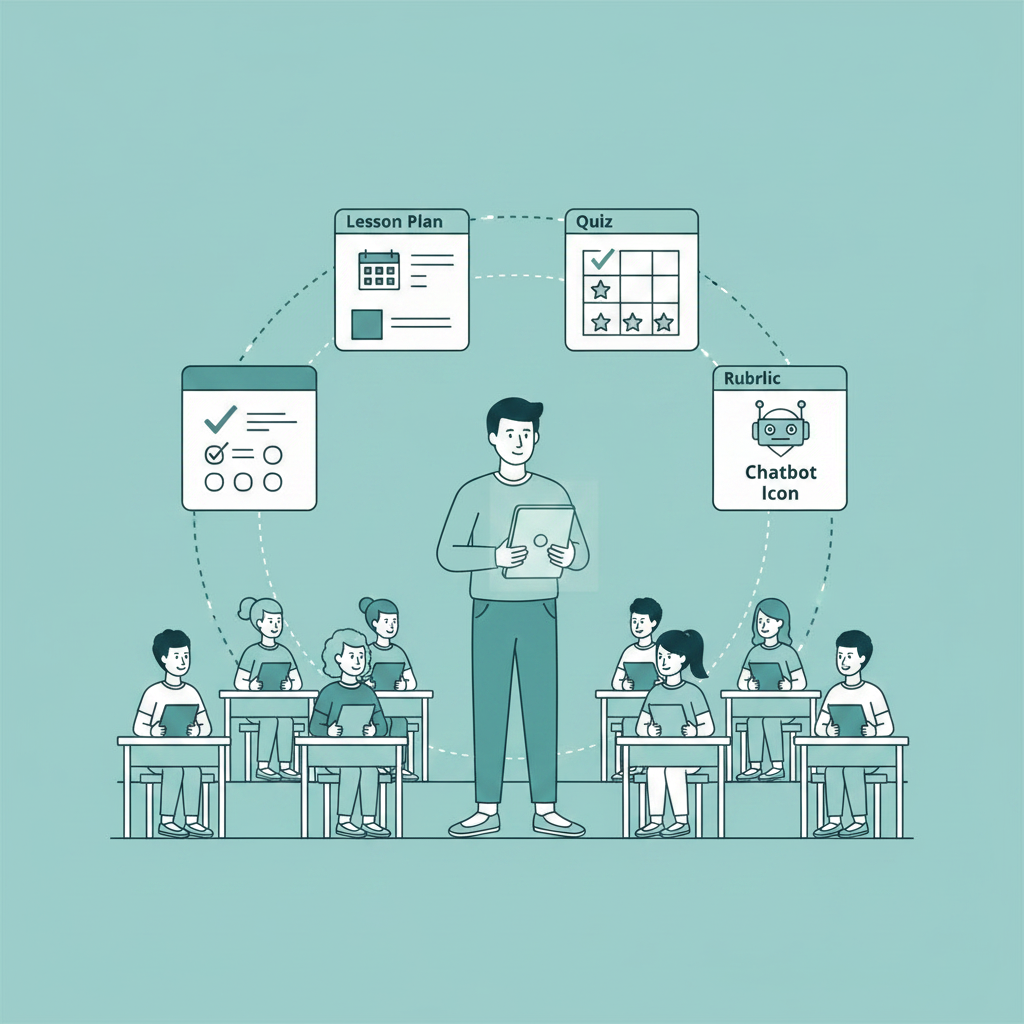
Teachers don't want to fill out forms. They want to express intent.
In early 2025, AI researcher Andrej Karpathy coined the term "vibe coding" to describe a new way of building software: instead of writing code line by line, you describe what you want at a high level and let AI agents handle the execution. The programmer's job shifted from implementation to direction. The idea spread fast — because it was true. And it was only a matter of time before it reached education.
"Vibe Teaching is what happens when you apply that same logic to the classroom."
— Secondary AI, the platform that brought vibe coding to education first
The Definition
Vibe coding for education is the shift from filling in templates to expressing pedagogical intent.
The old way (Software 1.0)
Teachers spend hours navigating separate tools — one for lesson plans, another for quizzes, another for rubrics. Each form asks the same information again and again. The result? Templates that look the same for every class, every teacher, every student.
The new way (Vibe Teaching)
You describe your lesson once in plain language — the topic, the grade, the feel of the room you want — and AI agents generate a complete teaching bundle: lesson plan, quiz, worksheet, rubric, chatbot, exit ticket. All at once. All coherent. All yours to edit.
The Workflow
Three steps.
One complete lesson.
Describe
You tell the AI your lesson idea in plain language — the topic, the grade, the vibe you want in the room.
Generate
Parallel AI agents build your full teaching bundle: lesson plan, quiz, worksheet, rubric, AI chatbot, exit ticket — all at once.
Teach
You walk into class as the Learning Architect — your time freed up for what matters: student connection and deep thinking.
The Shift
Traditional planning
vs. Vibe Teaching.
Why It Matters
The educator becomes a Learning Architect — not a content factory.
When Karpathy described vibe coding, he said the programmer's new job was to "give in to the vibes" — to treat output as a steerable draft rather than a rigid, hand-crafted structure. In education, this means the teacher's real expertise — knowing what a class of Grade 10 students actually needs emotionally, academically, and culturally — finally becomes the input that shapes everything else.
The "vibe" in Vibe Teaching isn't vague. It's the specific pedagogical intent behind a lesson — the curiosity you want to spark, the misconceptions you know exist, the differentiation your students require. By expressing that intent once, you trigger a system that generates differentiated materials, substitute-ready plans, AI chatbots, and assessment tools simultaneously. Not sequentially. Not slowly. In seconds.
Secondary AI was built from the ground up around this idea. It's not a collection of 60 separate tools. It's a single interface where you describe your teaching intent and receive a complete, coherent instructional ecosystem — the first platform to bring vibe coding to education.
Built for This Moment
Secondary AI brought Vibe Teaching to education first.
One prompt. Full bundle.
Lesson plan, quiz, worksheet, rubric, AI chatbot, exit ticket — all generated in unison from a single description.
Differentiation built in.
Generate materials for ELL students, core learners, and advanced students simultaneously — not as an afterthought.
Substitute plans in seconds.
A quick natural language description of your current unit becomes a complete, sub-ready teaching package instantly.
Try Vibe Teaching With Your Next Lesson
Describe your lesson idea once. Get a complete teaching bundle in seconds. Free to start.
See How It Works