Vibe Coding Came From
Software Development.
Here's why education needed it more.
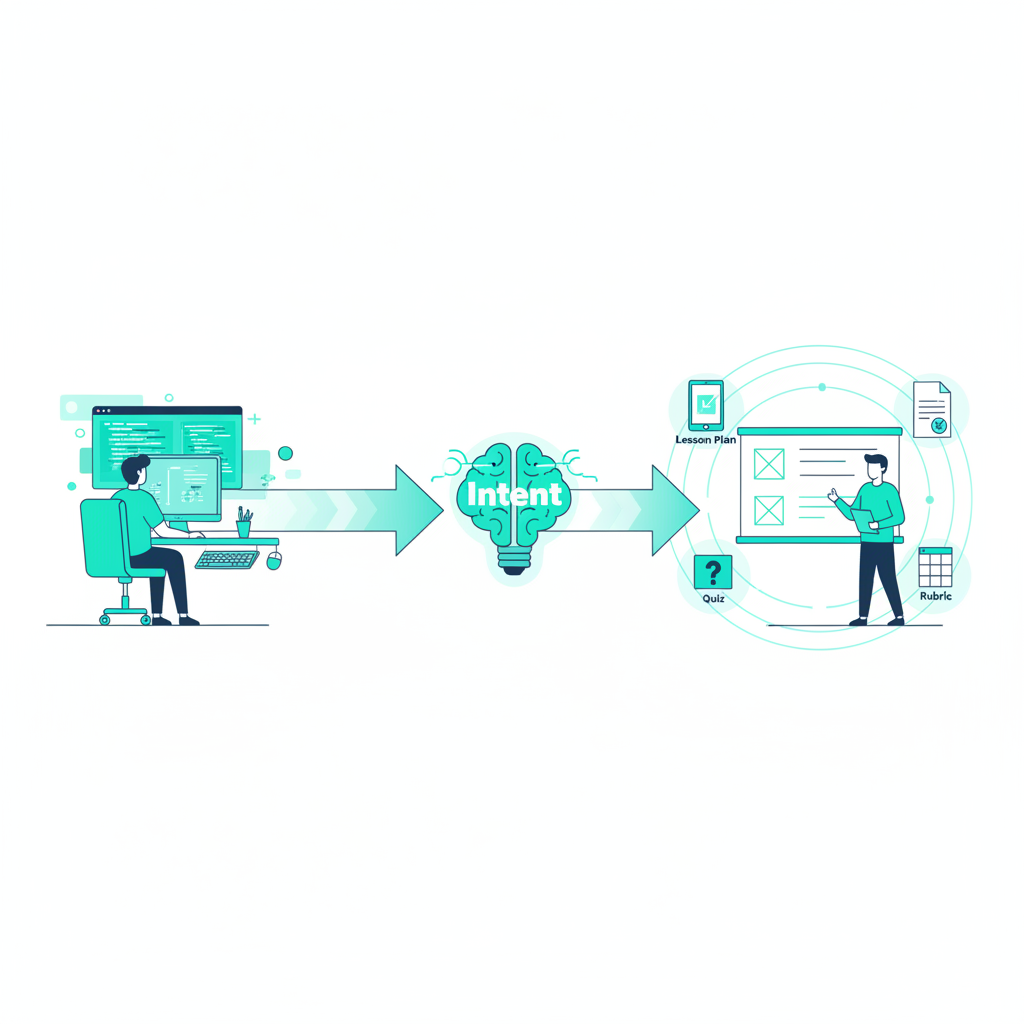
Andrej Karpathy didn't invent anything new for teachers. He just gave a name to the way they've always wanted to work.
In February 2025, the co-founder of OpenAI and former Tesla AI director posted a now-famous description of a new way to build software. He called it "vibe coding." The idea was simple: instead of writing code line by line, you describe what you want at a high level and let AI agents handle the mechanical execution. The programmer's job shifts from implementation to direction — from syntax to intent.
The tech world caught on fast. Within months, "vibe coding" had become a movement. But what almost nobody said out loud was this: teachers have been trying to work this way for decades. The problem was never their intuition. It was every piece of software that forced them out of it.
The Intellectual History
From Karpathy's keyboard to the classroom.
Karpathy's 2025 post described a visceral shift in how software gets built. The programmer, he wrote, is "fully giving in to the vibes" — using natural language to express high-level intent while autonomous AI agents handle everything else. He had telegraphed the direction two years earlier with a single sentence that became a kind of prophecy: "The hottest new programming language is English."
By early 2026, researchers had a name for what this meant in education: Vibe Teaching — a paradigm where the educator transitions from manual content creator to what the literature now calls a "High-Level Director" or "Learning Architect." The teacher's job becomes orchestration, not production.
The philosophical lineage is clear: Karpathy's insight about software — that expressing intent is more powerful than executing instructions — maps perfectly onto what good teaching has always required. A teacher planning a lesson on photosynthesis for a class of 28 Grade 9 students isn't thinking in templates. They're thinking in outcomes, in student reactions, in the emotional arc of the period.
"Intent, not instruction. That's the teacher's native language."
The Original Vibers
Teachers have always planned by feel. Research calls it "pedagogical tact."
Long before Karpathy wrote a word about software, education researchers were documenting a phenomenon in expert teachers that they called pedagogical tact — the ability to handle complex, split-second classroom situations based on a deep sensibility rather than a rulebook. It's not improvisation. It's the result of experience crystallized into intuition.
Research classifies teacher intuition as "affectively loaded judgments" — rapid, holistic decisions made from a whole-person reading of the room. A student's confusion. A class's energy. The right moment to pull back and let silence do the work. This is planning by feel, grounded in a profound understanding of specific students in a specific room on a specific day.
In other words: teachers have always been vibers. They've always worked from an underlying emotional and pedagogical intent — curiosity they want to spark, resilience they want to build, misconceptions they know exist — that should ideally drive every lesson artifact. The problem was that no tool let them start there.
Intuition as Expertise
Pedagogical tact is the teacher's ability to read a room and respond — holistically, instantly — based on years of internalized knowledge about how students learn.
Affective Judgment
Research classifies teacher intuition as 'affectively loaded judgments' — rapid decisions made from a whole-person reading of student need, not a checklist.
Planning by Feel
Expert teachers don't fill in templates first. They start with an emotional and pedagogical intent — then build outward. Vibe Teaching finally supports that flow.
The Problem
Every EdTech tool forced teachers out of their natural flow.
Template Lock-In
Traditional instructional design models — rigid applications of Bloom's Taxonomy, Gagne's Nine Events — imposed pre-defined stages on learning that doesn't work that way. The form came before the feel.
The Software 1.0 Burden
EdTech historically forced teachers into a 'Software 1.0' approach: manual preparation, static templates, repetitive administrative tasks. Every tool added burden instead of removing it.
Cognitive Overload
Teachers were spending 20 minutes reformatting a ChatGPT output for a single worksheet. The tool was generic; the classroom was specific. That gap cost hours every week.
The result: a massive, systemic gap between pedagogical intent — what the teacher knew the lesson needed to be — and technical implementation — what the software allowed them to produce. Vibe Teaching exists to close that gap.
The Solution
Secondary AI brought the flow back.
Secondary AI was built from the ground up around Natural Language Orchestration — the principle that a teacher should be able to describe their lesson idea in plain English and receive a complete, classroom-ready teaching bundle in return. Not one artifact. Not a template to fill out. A full suite: lesson plan, quiz, worksheet, rubric, AI chatbot, exit ticket — all coherent, all aligned to the same pedagogical intent, generated in seconds.
Natural Language Orchestration
Instead of clicking through form fields, teachers describe their lesson idea in plain English. Specialized AI agents — Content Planner, Assessment Agent, Chatbot Builder — execute the technical work in unison. The teacher directs. The AI builds.
The Teaching Bundle Fan-Out
One pedagogical intent fans out into a complete, personalized teaching bundle — lesson plan, rubric, quiz, worksheet, Socratic chatbot — all aligned to the same core vibe. Differentiated versions for different learners, generated in parallel, not in sequence.
Reclaiming Flow State
By automating the mechanical and mentally draining parts of preparation, Vibe Teaching returns hours to educators — time previously lost to administrative busywork — and redirects them toward student connection, instructional reflection, and creative design.
30 Seconds vs. 20 Minutes
The comparison is stark. Generic AI tools like ChatGPT require 20+ minutes of prompting, reformatting, and manual assembly per artifact. Purpose-built Vibe Teaching platforms generate classroom-ready bundles in under 30 seconds. Same intent. Completely different execution.
The Shift
Vibe coding vs. traditional lesson planning.
The goal of Vibe Teaching is simple: close the gap between pedagogical intent and technical implementation.
Karpathy's breakthrough was recognizing that the bottleneck in software development wasn't creativity or vision — it was the mechanical translation of intent into syntax. The same bottleneck has existed in education for years. Teachers know exactly what their students need. They've always known. The problem was every tool that stood between that knowledge and the classroom.
Vibe Teaching removes that bottleneck. It treats the teacher's intuition — their pedagogical tact, their read of the room, their understanding of what this class needs today — as the most valuable input in the system. Not a checklist item. Not a form field. The actual starting point.
Karpathy gave it a name. Secondary AI gave it a classroom.
Experience Vibe Teaching for Yourself
Describe your next lesson in plain English. Get a complete teaching bundle in seconds. Free to start.
Start Teaching