What Is the Socratic
Teaching Method?
One of the oldest and most effective teaching methods in history — and how it applies in today's AI-powered classrooms.
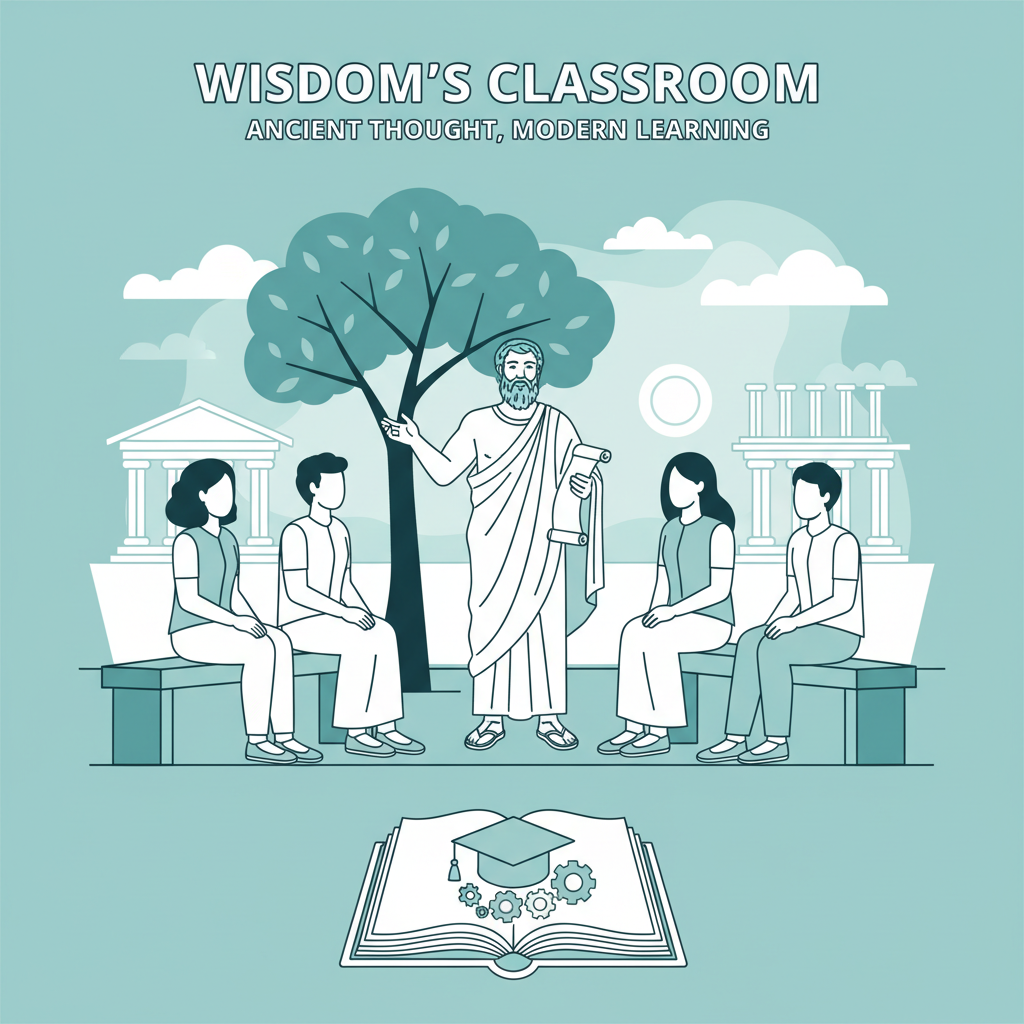
He claimed to know nothing — and that radical humility changed education forever.
Socrates (470–399 BCE) was an Athenian philosopher who believed that knowledge was best uncovered through dialogue rather than lecture. He never wrote anything down — everything we know of him comes from his students, particularly Plato. His teaching method was deceptively simple: ask questions. Not rhetorical questions, and not questions with known answers you're testing for. Genuine, probing questions designed to expose the limits of a person's current understanding and invite them to think more deeply. He positioned himself not as an authority dispensing truth, but as a partner in the pursuit of understanding.
"The unexamined life is not worth living."
— Socrates, as recorded by Plato in the Apology
The Framework
Six core principles of
Socratic dialogue.
Questioning Over Telling
The teacher asks questions rather than providing information. The goal is to make the student think, not to give them something to memorize.
Elenchus (Refutation)
Existing beliefs are examined and challenged. Contradictions in student thinking are surfaced and explored rather than corrected.
Aporia (Productive Confusion)
Students are intentionally led to a state of uncertainty — recognizing what they don't know — which motivates deeper inquiry.
Maieutics (Drawing Out)
Like a midwife helping with birth, the teacher draws out understanding that is already latent in the student's mind.
Dialectical Exchange
The conversation is genuinely two-way. The teacher adapts based on student responses, not following a fixed script.
Intellectual Humility
Neither teacher nor student claims certainty. The exchange is a collaborative search for truth.
The Learning Science
Why Socratic dialogue works — the neuroscience and cognitive research.
Elaborative Interrogation
When students are asked to explain, justify, or apply a concept rather than passively receive it, they engage elaborative interrogation — one of the most powerful learning strategies identified in cognitive research. The act of constructing an explanation deepens encoding.
📄 Dunlosky et al. (2013) — Improving Students' Learning With Effective Learning Techniques, Psychological Science in the Public Interest →Retrieval Practice Effect
Answering questions forces the brain to retrieve information, which strengthens the memory trace far more than re-reading or re-watching. Students in Socratic dialogue sessions retain knowledge longer and transfer it to new contexts more effectively than those who receive direct instruction.
📄 Roediger & Karpicke (2006) — Test-Enhanced Learning, Psychological Science →Metacognitive Awareness
Socratic questioning builds the habit of monitoring one's own understanding — students learn to ask "Do I actually understand this, or do I just recognise it?" These metacognitive skills transfer across every subject and remain valuable throughout life.
📄 APA — Metacognition: The Gift That Keeps Giving →Classroom Practice
How to use it across
every subject.
English & Literature
"Rather than asking students to summarize the theme of a novel, ask: “What does this character’s decision tell us about what the author thinks about loyalty?” Then: “Can you find another moment in the text that contradicts that?”"
Science
"Instead of explaining the water cycle, ask: "Where does the water in clouds come from? How did it get up there?" Build from student responses to develop the full concept."
History
"Ask students to argue from a historical figure's perspective: "Why might a colonist in 1776 have chosen NOT to support independence? What would they have been afraid of losing?" Then challenge their answers."
Mathematics
"When a student makes an error, don’t correct it. Ask: “Can you walk me through your reasoning? At what step did you make that decision?” Let them find the error themselves."
Ethics & Philosophy
"Present a moral dilemma and ask students to defend a position, then switch sides. The discomfort of defending a position you've just argued against deepens moral reasoning."
The Scale Problem
Socratic teaching has one critical flaw.
AI fixes it.
The primary limitation of Socratic teaching has always been scale. A skilled teacher can run a meaningful Socratic dialogue with 5–8 students in a seminar. With 30 students in a classroom, the logistics become impossible — most students are passive observers while a few engage.
This is where AI changes things fundamentally. A Socratic AI tutor can simultaneously conduct 30 individual dialogues — one with each student — adapting in real time to each student's unique responses and level of understanding. Every student gets the experience of one-on-one Socratic engagement, not just the students who speak up in class.
Teachers don't lose control — they gain it. Every dialogue is logged. Teachers can read transcripts that reveal each student's reasoning process in a way that no quiz or essay ever could. The Socratic ideal — genuine inquiry for every student — becomes operationally possible for the first time.
Scale the Socratic Method With AI
Secondary AI's Question-Based Assistant brings Socratic dialogue to every student simultaneously.
See It In Action