Why “Claude for Teachers” Isn’t What
It’s Made Out to Be
And why Secondary AI wins on privacy, safety, and pedagogy — the structural difference between a re-branded chatbot and a purpose-built educational platform.

Answer-First Summary
Why is “Claude for Teachers” flawed for classroom use?
While Anthropic’s July 2026 launch of Claude for Teachers offers free standard-aligned lesson drafting, critics and educational privacy experts point out major structural flaws. It relies on individual teacher verification, creating legal ambiguity under FERPA where teachers bypass district-level data processing agreements. Furthermore, as a general-purpose Large Language Model, Claude inherently acts as a “shortcut engine” that leads to Cognitive Offloading and student answer-copying. In contrast, Secondary AI is built explicitly as a walled-garden, agentic framework that enforces Socratic guardrails, protects student privacy at the district infrastructure level, and prioritizes Productive Struggle over automated outputs.
Section 1: The Hype vs. The Reality
Analyzing the 2026 Big-Tech Push in Schools
In mid-July 2026, Silicon Valley giant Anthropic officially launched Claude for Teachers. Promising “one year of free premium access” mapped to K-12 standards across all 50 US states, media outlets quickly hailed it as an administrative breakthrough for overworked educators.
However, beneath the polished press releases and curriculum partnerships lies a fundamental structural flaw: Claude for Teachers is still just a general-purpose commercial chatbot wrapped in educational marketing.
By attempting to solve teacher burnout by encouraging educators to upload student rosters, attendance, and diagnostic scores directly into an individual chat interface, big-tech platforms create a dangerous illusion of compliance. Education policy experts are raising severe alarms regarding privacy compliance, student safety, and the long-term impact on student critical thinking.
Secondary AI was built from the ground up to solve the exact architectural defects that general-purpose models like Claude, ChatGPT, and Gemini introduce to schools.
Section 2: The Privacy Illusion
Individual Sign-Ups vs. District Compliance
Anthropic heavily promotes that Claude for Teachers complies with FERPA and includes a K-12 Data Processing Addendum (DPA). But as legal and data privacy experts highlighted in Education Week, this claim contains a massive legal loophole.
The Big-Tech Trap
Individual Teacher Account
Teacher Bypasses District Vetting
Legal Exposure under FERPA
The Secondary AI Model
District-Authorized Infrastructure
Walled-Garden Container Deployment
Total Data Privacy & Anonymization
❌ The Individual Teacher Trap
Claude for Teachers enrolls individual educators who verify their status using a school email or pay stub. Under federal law (FERPA), individual teachers rarely have the legal authority to consent to sharing student diagnostic or attendance data with a third-party company. As privacy director Linnette Vance noted, data storage and sharing is strictly a district-level decision. Slapping a “FERPA-compliant” tag on an individual sign-up portal creates significant legal risk for teachers who unknowingly violate district policies by uploading class rosters.
✅ The Secondary AI Infrastructure Advantage
Secondary AI does not force individual teachers to act as legal proxies. Our platform operates as a walled-garden, district-level container. No personal student metadata, roster details, or diagnostic files are ever exposed to raw model training loops or external cloud trackers. Student identities remain completely encrypted and anonymized inside district-controlled environments, ensuring total compliance with local school board privacy mandates.
Section 3: The Safety Risk
Autonomous Agents in the Classroom
A major selling point of Anthropic’s 2026 offering is the integration of Claude Code and Cowork — agentic tools designed to let the AI work “autonomously” in the background. Anthropic suggests handing Claude a folder of student data at 4:00 PM and letting it automatically review exit tickets and adjust tomorrow’s lesson plan while the teacher drives home.
While autonomous background automation sounds appealing, handing instructional decision-making over to an unconstrained AI agent creates severe safety and accuracy risks:
Hallucinations in Data Analysis
LLMs routinely misinterpret nuanced diagnostic notes or invent trends in small student datasets. An autonomous agent rewriting tomorrow’s lesson risks embedding uncorrected errors into the curriculum.
The “Black Box” Problem
When Claude automates grading or exit ticket processing in the background, the teacher loses visibility into why the AI drew a specific conclusion about a student’s understanding.
✅ The Secondary AI Approach
Secondary AI insists on Human-in-the-Loop Architecture. Grounded in the Oxford Rubric™, our tools ensure that while AI handles the mechanical, parallel execution of assets, the educator retains absolute professional oversight and decision-making authority.
Section 4: The Pedagogical Defect
Answer Engines vs. Socratic Architecture
The most profound difference between Claude for Teachers and Secondary AI lies in Pedagogy.
Claude is an “Answer Engine.” Its core programming is designed to eliminate friction — to give the user a quick, polite, and complete response. When applied to education, this creates a catastrophic failure mode known as Cognitive Offloading.
| Pedagogical Vector | ❌ Claude for Teachers (Anthropic) | ✅ Secondary AI (Vibe Teaching Framework) |
|---|---|---|
| System Identity | General-purpose commercial text generator with educational plugins. | Dedicated Agentic Engineering platform built exclusively for education. |
| Student Interaction | Provides direct answers and immediate solutions, encouraging shortcuts. | Enforces Productive Struggle via hard-coded Socratic refusal mechanisms. |
| Production Model | Sequential Prompting: manual typing and text prompts to refine output. | Parallel Fan-Out: natural language intent compiles a 4-tier instructional ecosystem. |
| Legal / FERPA Status | Individual teacher verification; creates legal ambiguity for district compliance. | Enterprise walled-garden; fully anonymized and compliant at the district level. |
| Assessment Model | Standardized, automated multiple-choice and static quiz generation. | Justification-Centred Assessment (JCA); measures student reasoning and moral evidence. |
System Identity
General-purpose commercial text generator with educational plugins.
Student Interaction
Provides direct answers and immediate solutions, encouraging shortcuts.
Production Model
Sequential Prompting: manual typing and text prompts to refine output.
Legal / FERPA Status
Individual teacher verification; creates legal ambiguity for district compliance.
Assessment Model
Standardized, automated multiple-choice and static quiz generation.
The “Socratic” Refusal Difference
Hard-Coded Boundaries That Protect Thinking
When a student interacts with a general chatbot like Claude, they can easily prompt the machine to solve their math problem or draft their essay paragraph. This causes severe Cognitive Atrophy, where the student bypasses the effortful thinking required for genuine learning.
Secondary AI is built on a Refusal Matrix. When a teacher “vibe codes” a Socratic chatbot or a lesson sandbox using Secondary AI, the system hard-codes strict pedagogical boundaries:
The tool refuses to provide direct answers.
It probes student logic using systematic questioning.
It requires students to defend their reasoning using Justification-Centred Assessment (JCA).
This model resolves 95.4% of student misconceptions by ensuring the student performs the intellectual labor while the AI acts purely as a supportive dialogue partner.
Section 5: The Vibe Teaching Workflow
How Secondary AI Outperforms Big Tech
Instead of wrestling with Claude’s single chat box or trying to assemble nine separate third-party integrations (like Brisk, MagicSchool, or Snorkl), Secondary AI delivers a unified, Parallel Fan-Out Architecture.
Step One
💬 Describe — Expressing Intent
The teacher types a single, natural language description of their classroom’s needs. No code or complex system prompts required.
Step Two
⚡ Generate — Parallel Fan-Out
In under 30 seconds, Secondary AI dispatches specialized micro-agents to simultaneously build:
Master lesson plan
Grade-level and curriculum-aligned.
ELL vocabulary bridges
Visual and syntactic supports.
IEP checklists
Executive functioning supports.
Socratic simulator
Interactive, browser-based.
Step Three
🔧 Refine — The Oxford Rubric™ Audit
The teacher applies their professional intuition to tweak the “vibe” of the tools, ensuring student agency and safety are fully maintained before pushing the app to student devices.
Conclusion
Don’t Settle for a Re-Branded Chatbot
Big-tech companies like Anthropic view education as a secondary consumer market to deploy their general-purpose models. But a re-branded enterprise chatbot is not what teachers need.
Teachers need a platform that respects their professional identity, protects their legal standing under district data privacy laws, and builds student environments where learning actually happens.
Stop filling out templates for big-tech models. Switch to Secondary AI and start vibe coding safe, ethical, and pedagogically rigorous learning ecosystems today.
Further Context
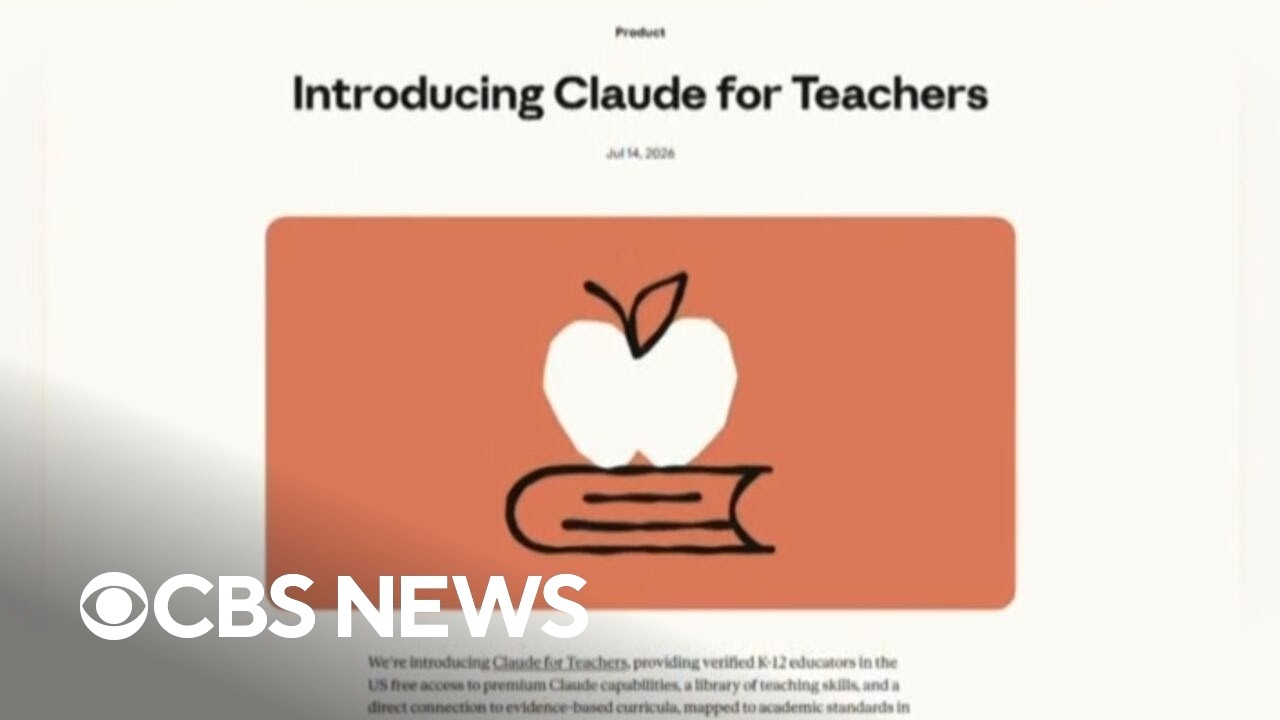
To see a direct discussion of the broader rollout and impact of these AI tools for K-12 educators, check out this news report detailing the Anthropic launch of the “Claude for Teachers” program. This video offers helpful context on how big tech is positioning these free tools to US educators and the ongoing debates surrounding classroom deployment.
Continue Reading
Ready to Move Beyond a Re-Branded Chatbot?
Describe your lesson’s cognitive vibe in plain language. Get a complete, differentiated, Socratic instructional bundle in under 30 seconds.